
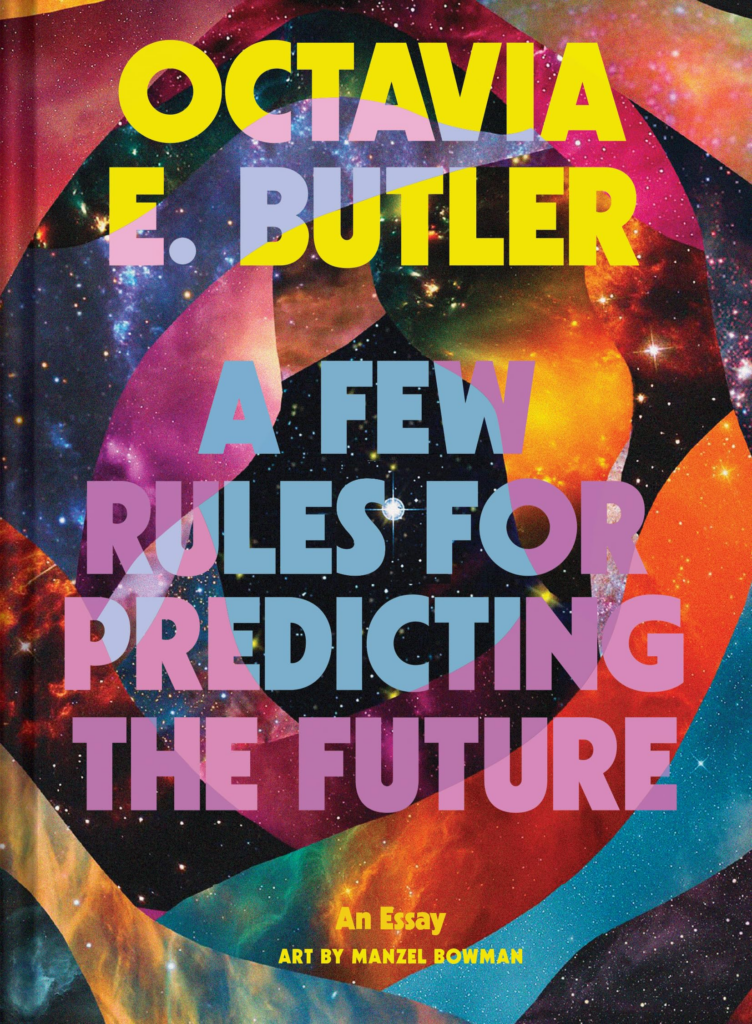
Predicting the Future (an homage to Octavia Butler)
As we move on from the November 5th election day, we ask ourselves “what’s next?” Or,
as the young man in Octavia Butler’s “A Few Rules for Predicting the Future” asks,
“what’s the answer?” We hope to engage the Legacy community in a discussion of the
future as we attempt to chart pathways forward. As Butler points out, “the very act of
trying to look ahead to discern possibilities and offer warnings is in itself an act of hope.”
For our first Salon on our redesigned website, Legacy seeks short pieces (no more than
1,000 words) that offer warnings for one another about what is over the horizon as well
as hope for those possible futures. You might want to propose a quote from an
American women writer, as we have done here, as a way to “predict the future.” Or you
might want to reflect on the life of a particular woman writer and/or activist who you think
provides a role model for concrete action as we enter another Trump presidency. Or you
might share your experiences in the classroom since the election and think about how
we can provide comfort and strength to a younger generation.
We will begin posting pieces in our Salon on Monday, December 2nd. To be posted on
this day, we need submissions by November 25th at the latest. Those that follow and
that are accepted for publication will be posted as they are received. Please send all
submissions to Jennifer Putzi at legacyeditor@wm.edu and Emma Thiébaut at
emmagthiebaut@gmail.com. Your email should have “Predicting the Future” in the
subject line.
Octavia Butler, “A Few Rules for Predicting the Future” (2020)
“SO DO YOU REALLY believe that in the future we’re going to have the kind of trouble
you write about in your books?” a student asked me as I was signing books after a talk.
The young man was referring to the troubles I’d described in Parable of the Sower and
Parable of the Talents, novels that take place in a near future of increasing drug
addiction and illiteracy, marked by the popularity of prisons and the unpopularity of
public schools, the vast and growing gap between the rich and everyone else, and the
whole nasty family of problems brought on by global warming.
“I didn’t make up the problems,” I pointed out. ‘All I did was look around at the problems
we’re neglecting now and give them about 30 years to grow into full-fledged disasters.’
“Okay,” the young man challenged. “So what’s the answer?”
“There isn’t one,” I told him.
“No answer? You mean we’re just doomed?” He smiled as though he thought this might
be a joke.
“No,” I said. “I mean there’s no single answer that will solve all of our future problems.
There’s no magic bullet. Instead there are thousands of answers–at least. You can be
one of them if you choose to be.”
Several days later, by mail, I received a copy of the young man’s story in his college
newspaper. He mentioned my talk, listed some of my books and the future problems
they dealt with. Then he quoted his own question: “What’s the answer?” The article
ended with the first three words of my reply, wrongly left standing alone: “There isn’t
one.”
It’s sadly easy to reverse meaning, in fact, to tell a lie, by offering an accurate but
incomplete quote. In this case, it was frustrating because the one thing that I and my
main characters never do when contemplating the future is give up hope. In fact, the
very act of trying to look ahead to discern possibilities and offer warnings is in itself an
act of hope.